
Thought Leadership
AI Agent Architecture Blueprint
AI Agent Architecture Blueprint
Technical assembly of LLMs, Vector DBs, RAG pipelines & Autonomous Workflows
1. The Brain: Understanding the Context Window
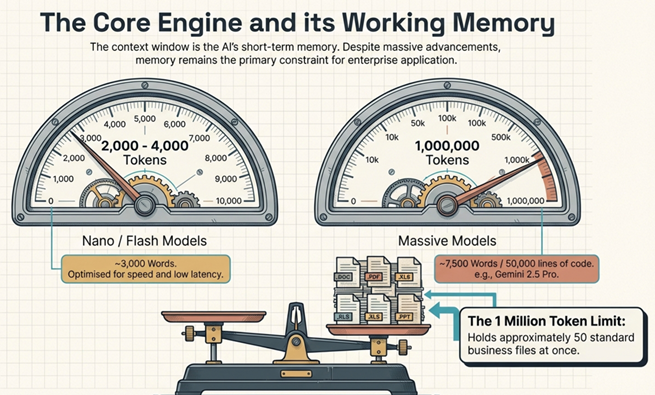
Every Agent starts with a Large Language Model (LLM). However, the “Short-Term Memory” of that model is its Context Window.
- The Limit: Even powerful models like Gemini 1.5 Pro (1M+ tokens) have limits. You can’t feed a 500GB company database into a single prompt.
- The Strategy: Choosing the right model (Flash/Nano for speed vs. Pro for deep reasoning) is your first architectural decision.
2. The Memory: Embeddings & Vector Databases
To handle massive data Agents use Embeddings, converting words into mathematical vectors that represent meaning rather than just keywords
- Semantic Search
- The Stack: Tools like Pinecone or ChromaDB act as the external long-term memory for your agent.
3. The Strategy: Retrieval Augmented Generation (RAG)
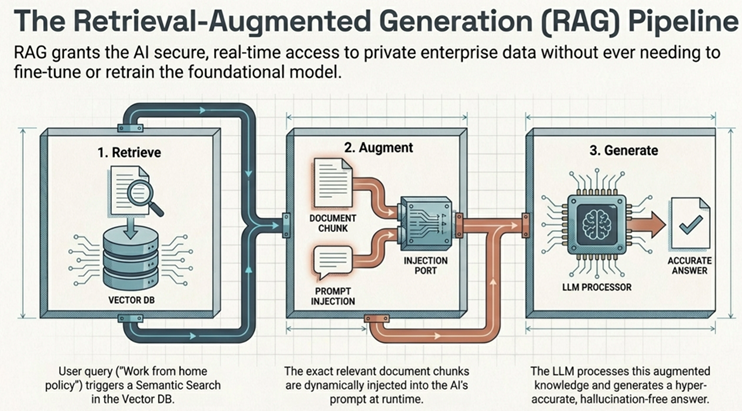
RAG is the “secret sauce” that prevents AI hallucinations. It follows a three-step flow:
- 1. Retrieval: Finding relevant document chunks in the Vector DB.
- 2. Augmentation: Injecting that specific data into the prompt.
- 3. Generation: The LLM answers based only on the provided facts.
4. The Skeleton: LangChain & Orchestration
Building everything from scratch is inefficient. LangChain acts as the abstraction layer, allowing you to:
- Switch LLM providers (OpenAI to Anthropic) with one line of code.
- Manage “Chains” of events automatically.
- Standardize how the agent uses memory and tools.
5. The Nervous System: LangGraph for Complex Workflows
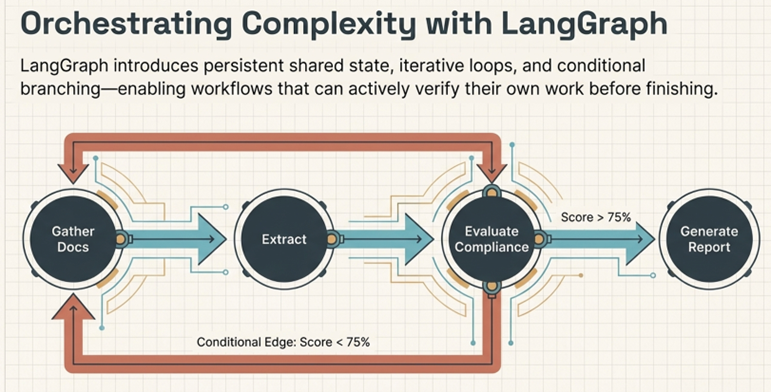
Standard “Chains” are linear, but real business logic is loopy and conditional. LangGraph introduces:
- Nodes:Individual units of work.
- Edges:The paths between nodes, including conditional branching .
- State:A shared “memory” that persists across the entire multi-step process .
6. The Hands: Model Context Protocol (MCP)
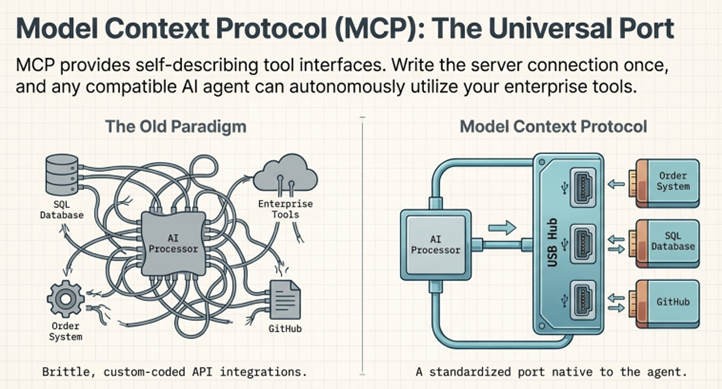
How does an agent actually do things? Through MCP. Think of it as a universal USB port for AI.
- It allows agents to connect to external SQL databases, Slack, GitHub, or local files autonomously.
- Benefit:Instead of writing custom APIs for every tool, you use self-describing interfaces that the AI understands how to use on its own.
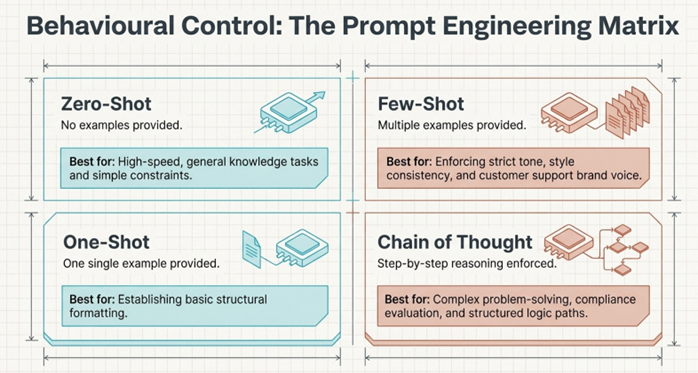
7. The Voice: Prompt Engineering
The way you “talk” to the agent determines its success. Key techniques include:
- Few-Shot:Giving the agent 2-3 examples of the desired output style.
- Chain of Thought:Explicitly telling the agent to “think step-by-step” before answering.
The Result?
By combining these layers, companies are moving from long Manual process tasks to few minutes with 24/7 availability.
Are you building agents for your workflow yet?
Get in touch today to discover how CubeMatch can support your business https://cubematch-144313631.hs-sites-eu1.com/get-in-touch
// EXPLORE Thought Leadership
Every change starts with a conversation.
Let's chat about how CubeMatch can drive your transformation.
Get in touch to see how we can work together to make a difference for your business.